
What is an IVA?

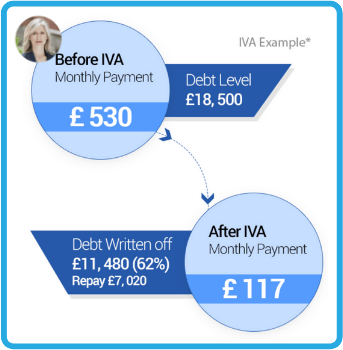
An IVA stands for an Individual Voluntary Arrangement. It is a Formal arrangement set out between you and the unsecured creditors, (credit cards, loans, store cards, catalogues etc). You will make affordable monthly payments, usually over 5 or 6 years, after which the debts included in your IVA will be cleared. An IVA can only be set up by a certified IP (Insolvency Practitioner). The IP will deal directly with your creditors and support you for the full 60 month period.

Start your journey by completing the form.

Some Disadvantages of an IVA

ADVANTAGES OF AN IVA
  • Write off remaining debts & get debt free
  • FREEZE all the interest payments on your unsecured debts
  • Stop all collection calls, bailiffs and creditor hassle
  • An IVA will last for a fixed period of time, normally no longer than 5 years
  • Once an IVA is in place, your creditors are not allowed to take further legal action against
    You will not be credit blacklisted for life
DEBT MANAGEMENT

Debt Management Plans are designed to help those who may not be able to afford the full monthly payments on their accounts but are in a position to make a lower payment on a regular basis. After completing a fact find of your income and outgoings we will be able to identify exactly how much you can reasonably afford to put aside for your creditors.

Advantages
  • Reduce all of your debts into one monthly payment to suit your circumstances
  • Once on debt management your creditors sometimes agree to freeze your interest and charges for the term of the plan.
  • Retain complete flexibility of the agreement in the event that your financial situation changes
  • Results in full and final settlement of your balances •All contact from creditors is dealt with on your behalf
  • Available throughout the UK, irrespective of legal jurisdiction
Disadvantages
  • It may take significantly longer to repay your debts by making reduced monthly payments
  • None of your outstanding debt is written off
  • Your creditors will notify credit agencies which will affect your score for up to six years
  • A Debt Management Plan will not protect you from further legal action
  • Management fees may apply for this service
DEBT RELIEF ORDER

A Debt Relief Order (DRO) is a very useful debt solution introduced by the government in 2009 and is designed to provide a fresh start for those with less than £20,000 of debt and no assets of value.
DROs work in a very similar way to Bankruptcy although it is seen as a far simpler process with smaller amounts of mo ney being written off to safeguard your financial future. Each DRO lasts for just one year, at which point you will be free from debt and the associated stresses.

Advantages
  • The majority of any outstanding balances can be written off completely
  • Debt Relief Order payments continue for a period of one year
  • Creditor contact and further collection arrangements will cease once the order is in place
  • Additional charges and interest will be frozen on creditor acceptance of a DRO Receive protection from further legal action from creditors by simply maintaining pre-agreed monthly payments
Disadvantages
  • Qualifying for a DRO can be difficult due to stringent acceptance criteria.
  • Future changes in your finances can lead you to becoming liable for the whole balance again
  • You will be registered as insolvent and therefore fees may apply
  • Those with over £20,000 of debt will not be eligible for a DRO
  • Your bank account may be shut down as a result of accepting a DRO and restrictions may be place on opening certain types of account in the future Your credit file will be affected for up to six years as will your ability to obtain new credit
BANKRUPTCY

Bankruptcy is a legal process through which people who cannot repay debts to their creditors may seek relief from some or all of their debts. Bankruptcy is often seen as the last resort, but for those with severe debt problems, this can be a lifeline.
The bankruptcy process begins with a petition filed by the debtor, which is most common, or on behalf of creditors, which is less common. All of the debtor’s assets are measured and evaluated, and the assets may be used to repay a portion of outstanding debt.
Advantages
  • Monthly creditor payments are reduced into one affordable amount, usually payable for no more than three years
  • The majority of debt can be written off altogether
  • Provides legal protection from creditors as well as further charges and interest
  • Established by the government specifically to clear large amounts of debt which can’t be paid
  • Creditors are forced to abide by the order as set out by the courts Further communications and collection measures will cease as soon as the order is in place
Disadvantages
  • Bankruptcy will have an adverse impact on your ability to retain credit in the future
  • You may lose your bank accounts and lose access to certain account types for a limited period
  • You will be placed on the insolvency register
  • Any sizeable assets such as your home or car will be used to settle some of the debt
  • Not available to customers living in Scotland Fees apply for this service as part of the court arrangements and insolvency

Debts you can include in an IVA

An IVA can include the following types of debts

  • Credit cards
  • Bank & building society loans
  • Overdrafts
  • Store cards
  • Personal loans
  • Charge cards
  • Catalogues
  • Council tax arrears
  • Tax debts
  • Electricity and gas debts